 Simulador solar LED Módulo de placa PCBA 200-1750NM

Projetando um sistema óptico de LED para simular a luz solar natural
1. Optical System Operating Principle
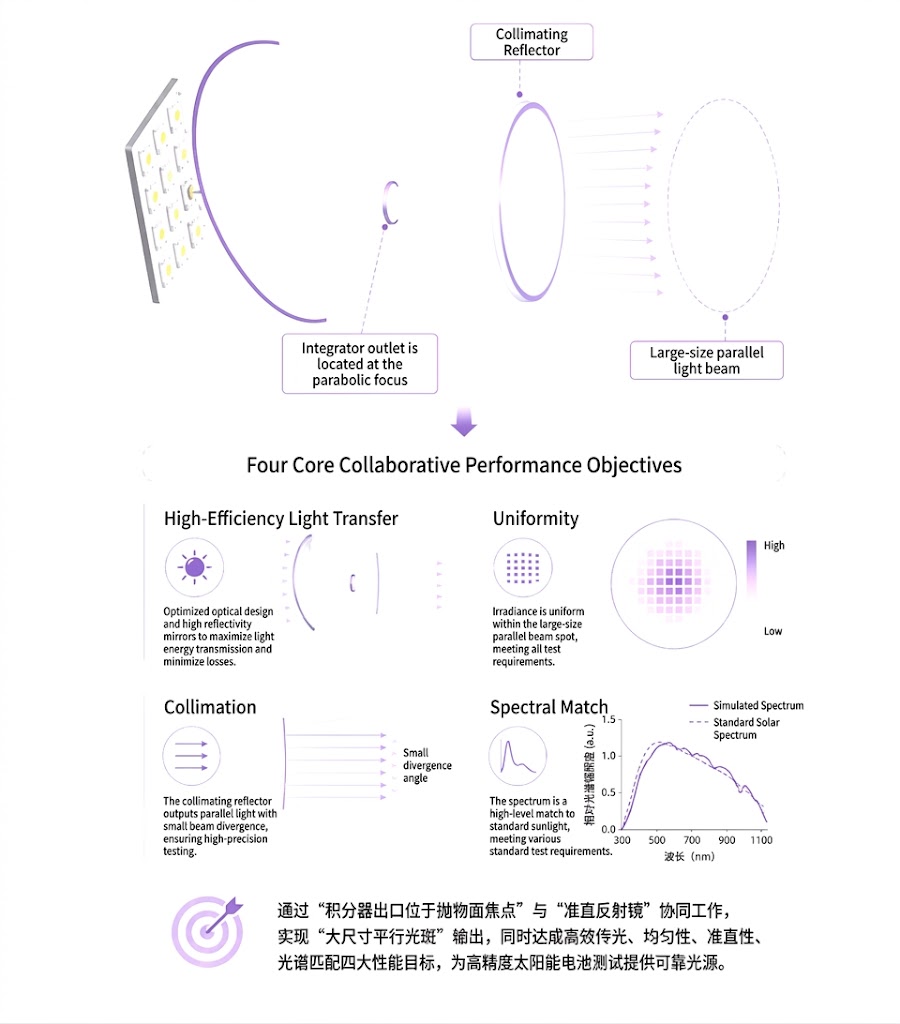
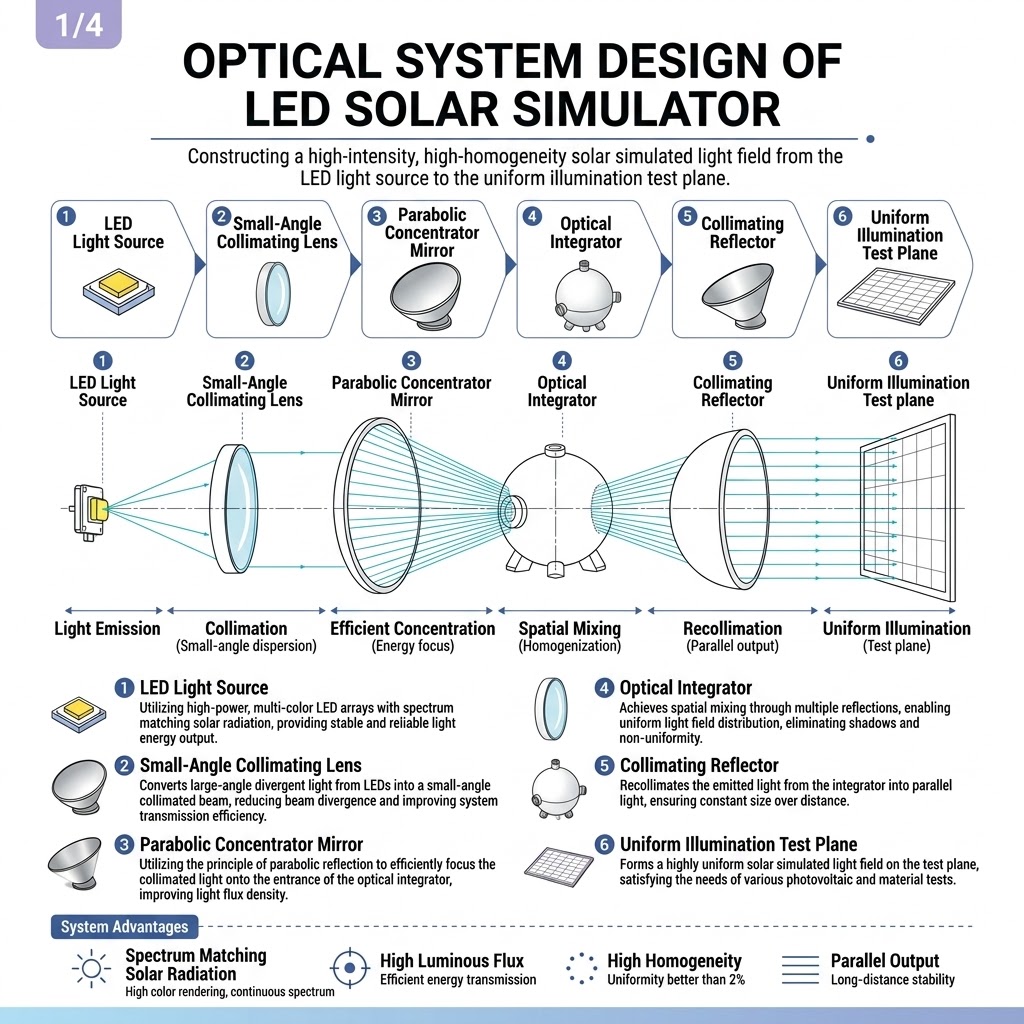
The system achieves precise sunlight simulation—matching standard spectrum, uniformidade espacial, e alta colimação – através da integração coordenada de um conjunto de LED, lentes de colimação, um espelho condensador, an optical integrator, and a collimating reflector.
2. Light Source & Spectral Architecture
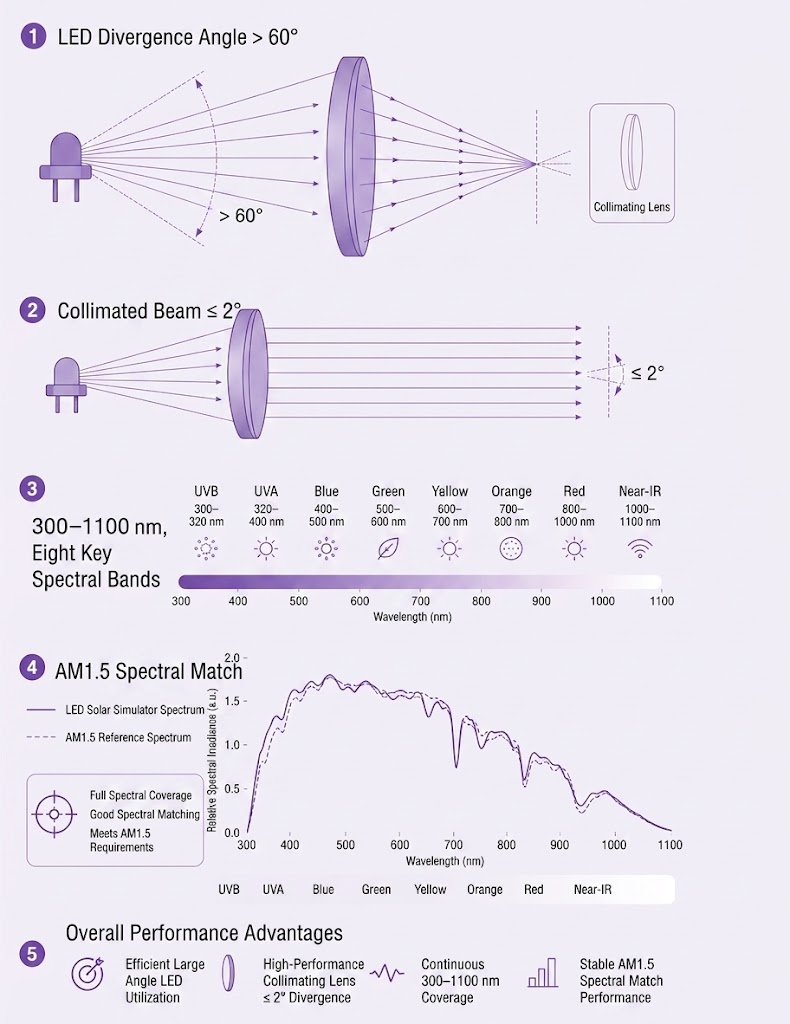
Narrow-beam collimating lenses reduce the native Lambertian emission of the LED chips to a divergence half-angle within 2°. The system precisely fits the AM1.5 standard solar spectrum by synthesizing eight critical sub-bands across the 300–1100 nm wavelength range.
3. Light Concentration & Homogenization
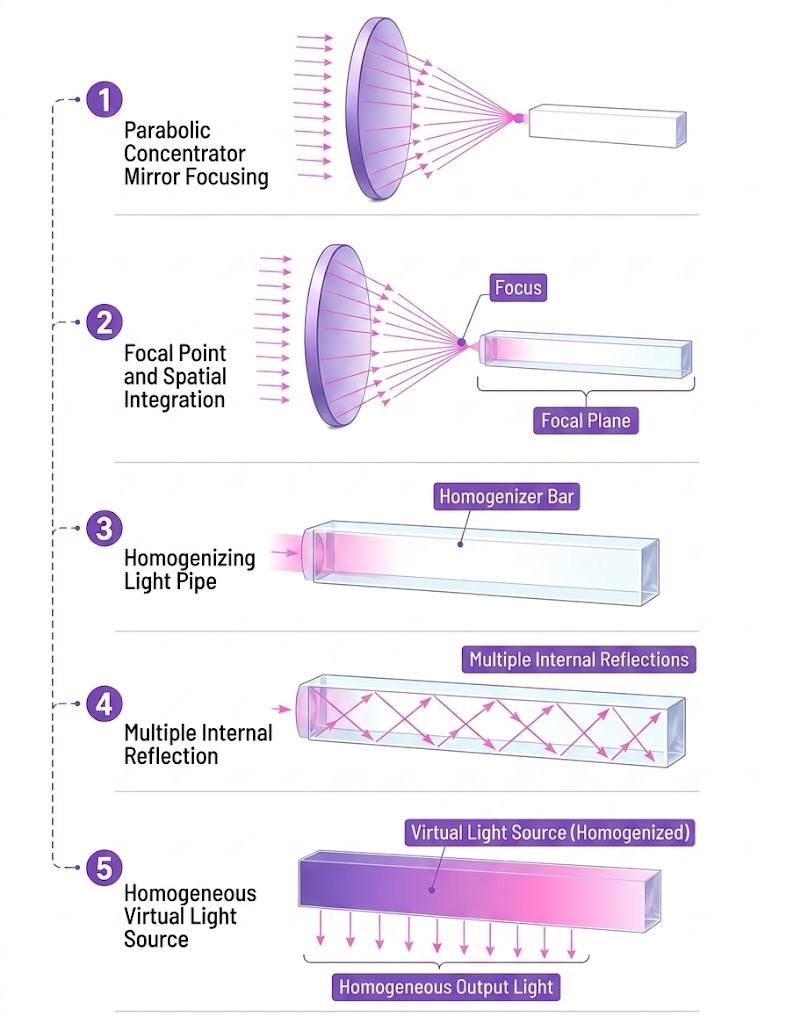
A parabolic condenser mirror efficiently collects and focuses light to minimize energy loss. Downstream, an optical integrator creates multiple virtual source superpositions through internal reflections, converting non-uniform beam profiles into a highly homogeneous light field.
4. Collimated Output & Performance Specifications
A high-precision collimating reflector delivers the final large-area, parallel beam. The Heyi system covers an extended 300–1200 nm range, achieving a spatial non-uniformity of just 1.8% over a 45 cm × 45 cm target area with temporal instability $\le 0.5\%$ over 20 minutes.