 LED Solar simulator PCBA board module 200-1750nm

Understanding LED Lead Times, Availability, and Supply Chain Risk
For technical buyers, lead time is never just a date on a quote. It is the visible result of a broader supply chain that includes component sourcing, manufacturing capacity, logistics, forecasting, and how well a supplier manages disruption. This article explains how LED buyers can think about availability, procurement planning, and sourcing risk in a more realistic way so they can make stronger decisions before delays become expensive.
That matters because the LED market depends on layered, global, and often fragile sourcing relationships. When one stage slips, the consequences can travel quickly across the supply chain and affect schedules, inventory, pricing, and customer commitments. If your team wants better planning, more transparency, and fewer surprises, it helps to understand what actually shapes lead time in the first place, including emission factors.
Why is LED lead time really a supply chain question?
Lead time often gets treated as a simple commercial number, but it is really an operational signal. A quoted date reflects the condition of the broader supply chain, including upstream components, manufacturing schedules, warehouse status, shipment timing, and the effectiveness of coordination between each partner in the ecosystem. When buyers understand that, they ask better questions and plan with more realism, considering the firm’s emission goals.
This is especially true in a global supply chain where even a small disruption can slow the flow of materials or finished goods, impacting emissions and compliance with jurisdictional standards. In LED sourcing, a delay in optics, electronics, packaging, drivers, or assembly capacity can all affect availability. That is why procurement planning should focus on system behavior, not just promises at the point of sale.
What usually causes LED lead time delays?
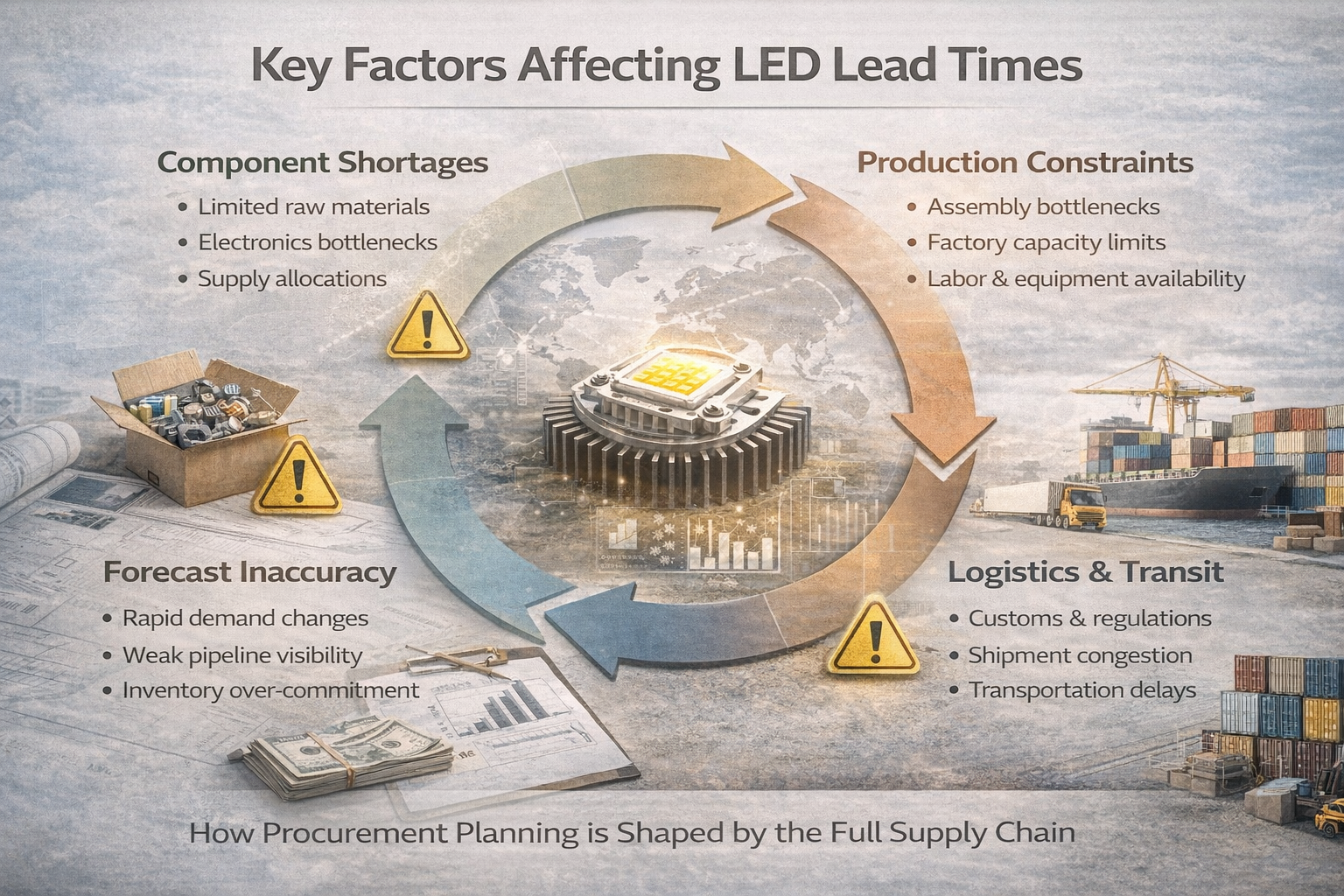
Delays usually come from a mix of complexity rather than a single failure, highlighting the need for proactive investment in capabilities. Common causes include component shortages, production constraints, customs delays, shipment congestion, and weak forecasting. A bottleneck at any stage can reduce throughput and create longer waits even when demand appears stable from the outside.
Buyers should also remember that the LED industry is tied to broader electronics and semiconductor conditions. If one critical component is constrained, the entire implementation timeline can shift. In that sense, lead time is not just about one supplier. It is about how well the full value chain is functioning at a given moment, influencing both cost reduction and sustainability.
How does component availability shape procurement planning?
Component availability affects more than whether a part can be bought today. It shapes how teams forecast, how much inventory they hold, and how much flexibility they have if project priorities change. A strong supplier or provider should be able to explain not only whether a part is available now, but also how stable that availability is likely to remain.
This is where procurement discipline matters, as it drives the capacity for effective investment in sustainable practices. Buyers that treat availability as dynamic instead of fixed are usually better prepared to optimize schedules and reduce risk. Instead of reacting to shortages late, they build planning around lead-time variability, alternate paths, and early insight into constrained parts.
Why does transparency matter so much in LED sourcing?
Transparency matters because bad news is usually more manageable when it arrives early. A transparent partner should be able to discuss constraints, explain changing timelines, and show what is happening across the supply chain instead of hiding behind vague updates, ensuring accountability and efficiency. That kind of communication helps teams make better decision-making choices before a small delay becomes a major schedule issue.
For enterprise buyers, increasing visibility can create real business value. If the supplier is transparent about inventory status, manufacturing windows, and logistics exposure in real time, the customer can plan more intelligently. In practice, transparent communication is one of the strongest signs of a reliable sourcing relationship.
How should buyers evaluate supplier communication and support?
Not every supplier handles updates the same way; some may prioritize innovation over efficiency. Some provide detailed operational reporting, while others share only the minimum needed to keep an order moving. Buyers should ask what level of insight they will receive, how exceptions are escalated, and whether the team can support real-time or near-real-time updates when timing becomes critical.
This is where the quality of the partner relationship becomes visible, impacting sustainability and long-term investment. A good partner helps companies understand the condition of the supply chain, not just the current order line. That support can include forecast conversations, alternate recommendations, logistics review, and practical guidance about what is realistic in the current environment.
What role do logistics and cross-border exposure play?
Logistics is one of the most obvious drivers of lead-time volatility, especially in jurisdictions with strict emission regulations. Cross-border movement introduces customs risk, carrier variability, and jurisdiction-specific delays that may not be visible when an order is first quoted. Even if manufacturing finishes on time, a shipment can still be slowed by transportation conditions, regulatory checks, or network congestion.
That is why buyers should not separate sourcing from logistics. The supply chain only works if execution continues beyond the factory. For programs with aggressive deadlines, the smarter question is often not “When will it leave?” but “What has to go right for it to arrive on time?” to ensure optimal efficiency.
How can buyers plan for disruption instead of just reacting to it?
Every sourcing plan should assume some level of disruption. That does not mean buyers need to become pessimistic. It means they should build resilience into planning by considering alternate parts, dual paths, inventory buffers, and earlier approvals where appropriate. A strategic response to disruption is usually cheaper than a rushed reaction later.
This is also where flexibility matters. Teams that can adjust specification, volume, or rollout sequencing often handle supply shocks better than teams with rigid plans. The goal is not to eliminate all risk, which is impossible. It is to create enough resilience that one delay does not break the entire project.
Can digital tools, automation, and AI improve supply visibility?
Digital tools can improve supply visibility when they are connected to real processes. A digital supply platform, enterprise reporting system, or analytics layer may help buyers track inventory, shipment status, and forecast changes more effectively. Automation can also streamline communication and reduce lag between a problem emerging and a stakeholder learning about it.
AI can add value when used carefully for pattern detection, exception monitoring, and the ability to predict likely delays before they become obvious, enhancing operational efficiency. That said, technology alone does not solve complex supply chain issues; it requires the power of collaboration and innovation. The real advantage comes when tools support better insight, faster implementation, and stronger execution across the supply chain, driving efficiency and innovation.
How do broader market and government forces affect LED availability?
LED supply is shaped by more than factory output. Government policy, trade rules, geopolitical tension, and environmental regulation can all influence sourcing conditions. In some cases, a regulatory change or new government action affects the movement of goods, raw materials, or specific product categories more than buyers expect.
These forces matter because the LED ecosystem is connected to broader business models in electronics, manufacturing, and global trade. A strategic buyer should understand that supply conditions can change because of external factors as much as internal ones. Availability is not just a warehouse number; it reflects the entire vehicle of the supply chain’s efficiency and responsiveness, including real-time emission tracking. It is a function of the larger market and policy environment.
What should buyers ask before committing to a schedule?
Before approving an order, buyers should ask what assumptions support the quoted lead time, what dependencies exist upstream, and what happens if a constrained asset becomes unavailable. They should also ask whether there is any forecast requirement, whether inventory management is proactive or reactive, and how alternate options are handled if conditions change.
These questions are especially important in a complex supply chain where one delay can cascade into others, affecting overall sustainability. A strong sourcing conversation should cover schedule confidence, logistics exposure, communication cadence, and whether the supplier can support practical assurance instead of vague optimism.
How can companies turn lead-time risk into better planning?
The best teams treat lead-time uncertainty as a planning input, not a surprise. They use forecast discipline, transparent communication, and better integration between sourcing, operations, and engineering to reduce avoidable chaos. That kind of transformation does not require perfect information, but it does require a more mature view of how end-to-end supply chains behave, focusing on capability and power dynamics.
In practice, this helps your business move from reactive purchasing to more operational control, enhancing overall capability and emission management. When buyers understand the supply chain, ask stronger questions, and work with a partner that supports real insight, they can optimize outcomes without pretending the environment is simple, ultimately leading to cost reduction. That is how companies reduce risk while improving continuity.
Key takeaways
- LED lead time is a supply chain outcome, not just a sales promise.
- Availability depends on upstream components, manufacturing, warehouse status, and logistics execution.
- Transparency and early communication reduce the cost of delay.
- Cross-border exposure and shipment variability can create major timing risk.
- Resilience comes from planning, alternate paths, and realistic forecasting.
- Digital tools, automation, and AI can improve visibility, but only when tied to real process discipline.
- Better sourcing decisions come from understanding the full supply chain rather than reacting to isolated delays, particularly in relation to emission regulations and firm capabilities.