 Module de carte Solar Somilateur LED 200-1750 nm

Designing an LED Optical System to Simulate Natural Sunlight
1. Optical System Operating Principle
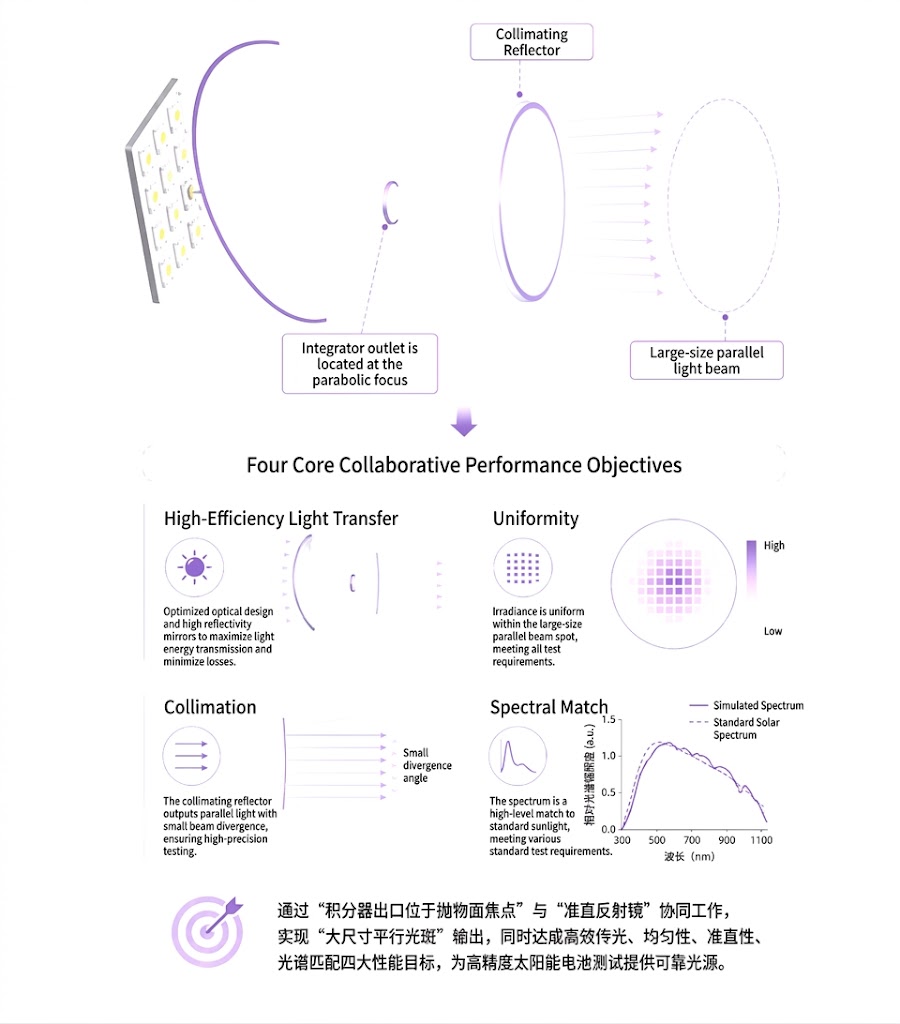
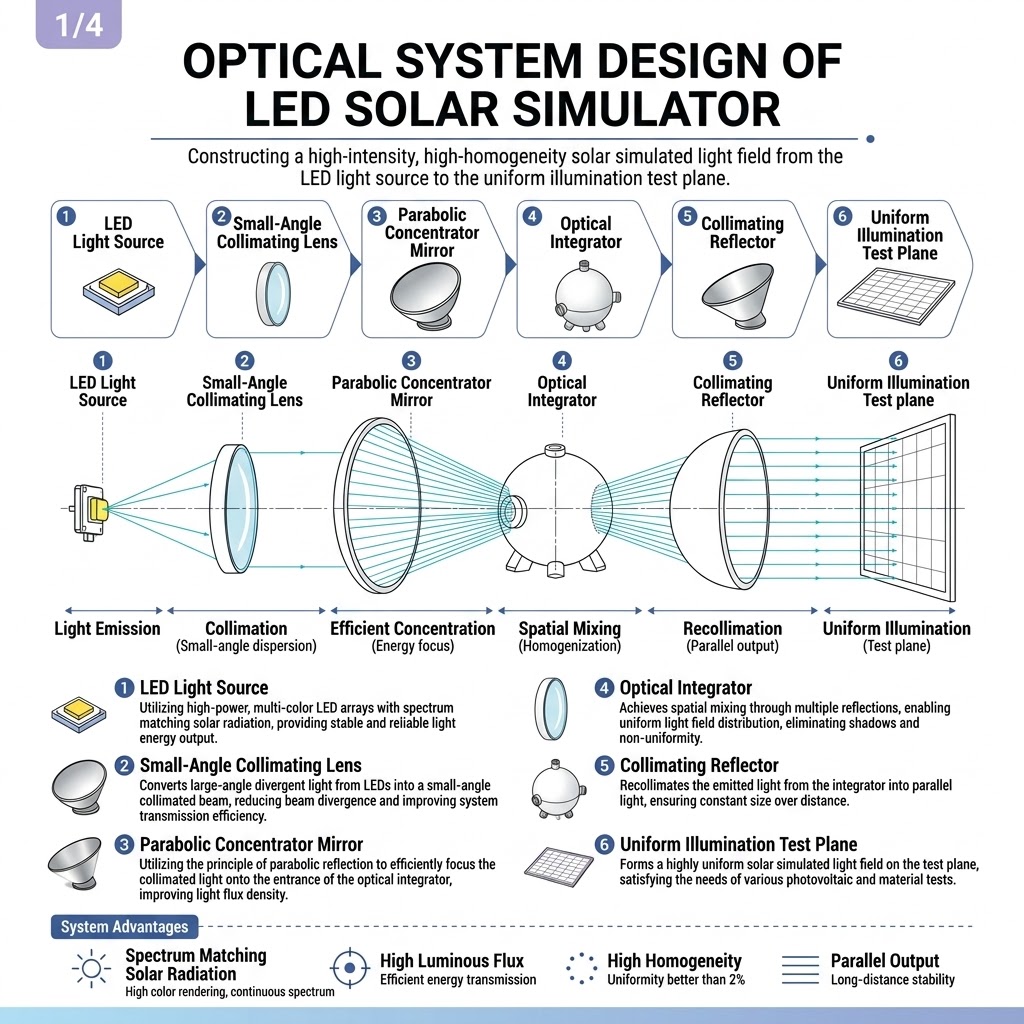
The system achieves precise sunlight simulation—matching standard spectrum, spatial uniformity, and high collimation—through the coordinated integration of an LED array, collimating lenses, a condenser mirror, an optical integrator, and a collimating reflector.
2. Light Source & Spectral Architecture
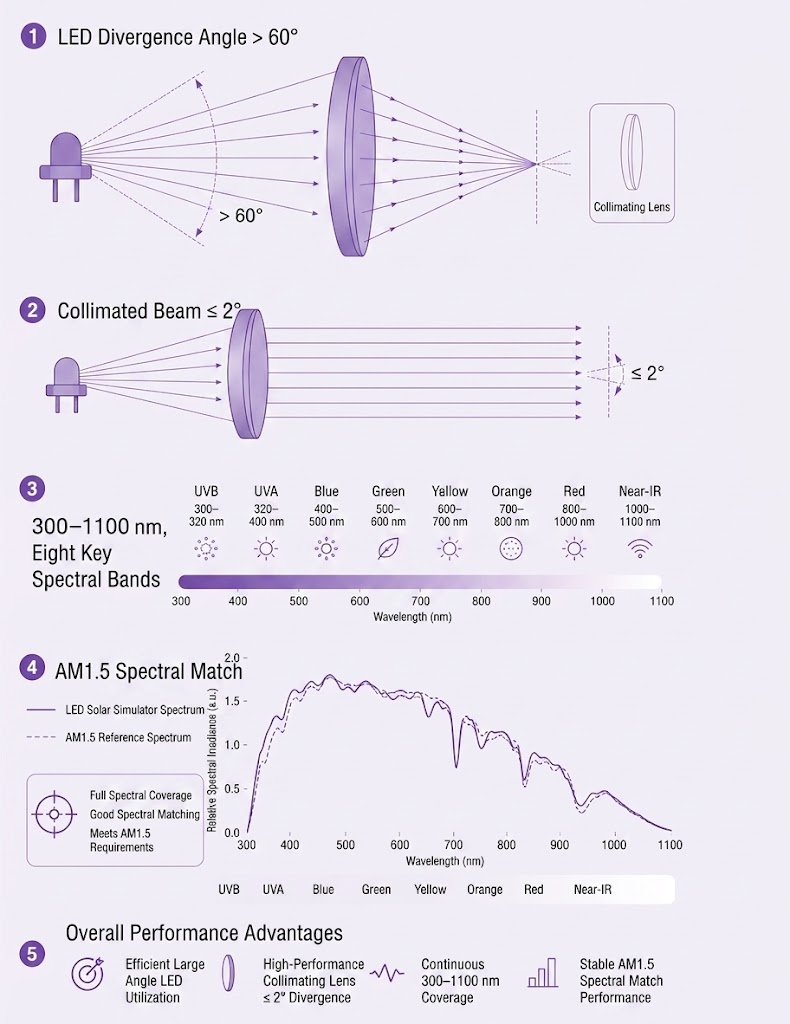
Narrow-beam collimating lenses reduce the native Lambertian emission of the LED chips to a divergence half-angle within 2°. The system precisely fits the AM1.5 standard solar spectrum by synthesizing eight critical sub-bands across the 300–1100 nm wavelength range.
3. Light Concentration & Homogenization
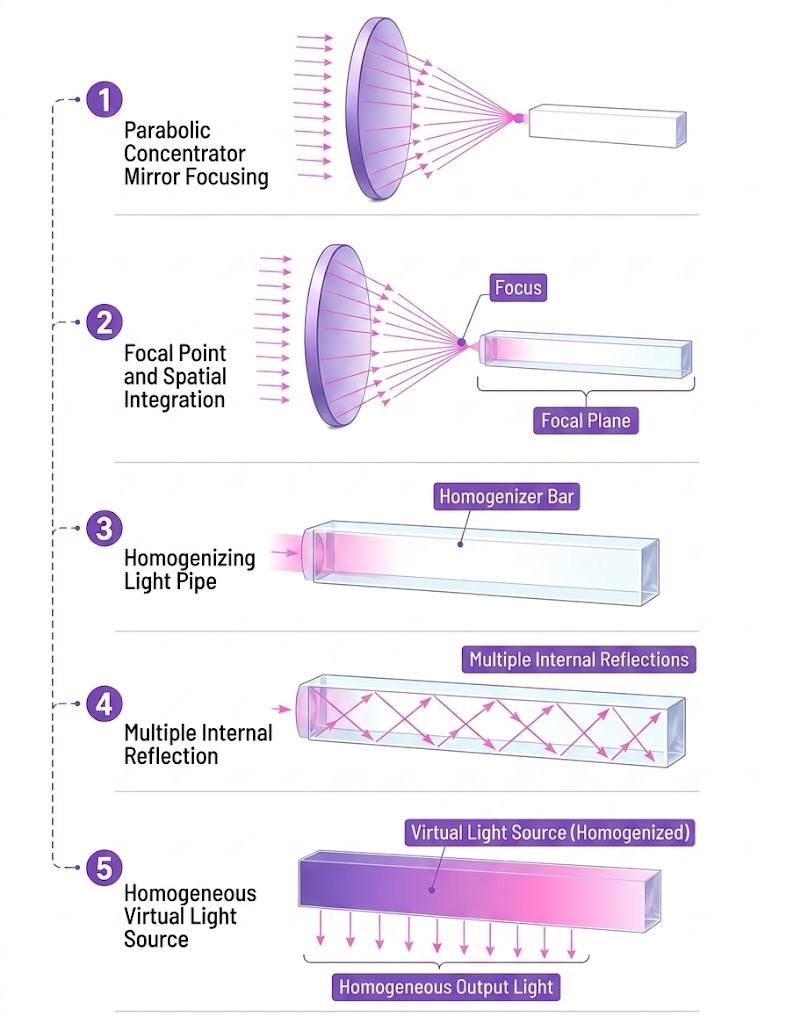
A parabolic condenser mirror efficiently collects and focuses light to minimize energy loss. Downstream, an optical integrator creates multiple virtual source superpositions through internal reflections, converting non-uniform beam profiles into a highly homogeneous light field.
4. Collimated Output & Performance Specifications
A high-precision collimating reflector delivers the final large-area, parallel beam. The Heyi system covers an extended 300–1200 nm range, achieving a spatial non-uniformity of just 1.8% over a 45 cm × 45 cm target area with temporal instability $\le 0.5\%$ over 20 minutes.